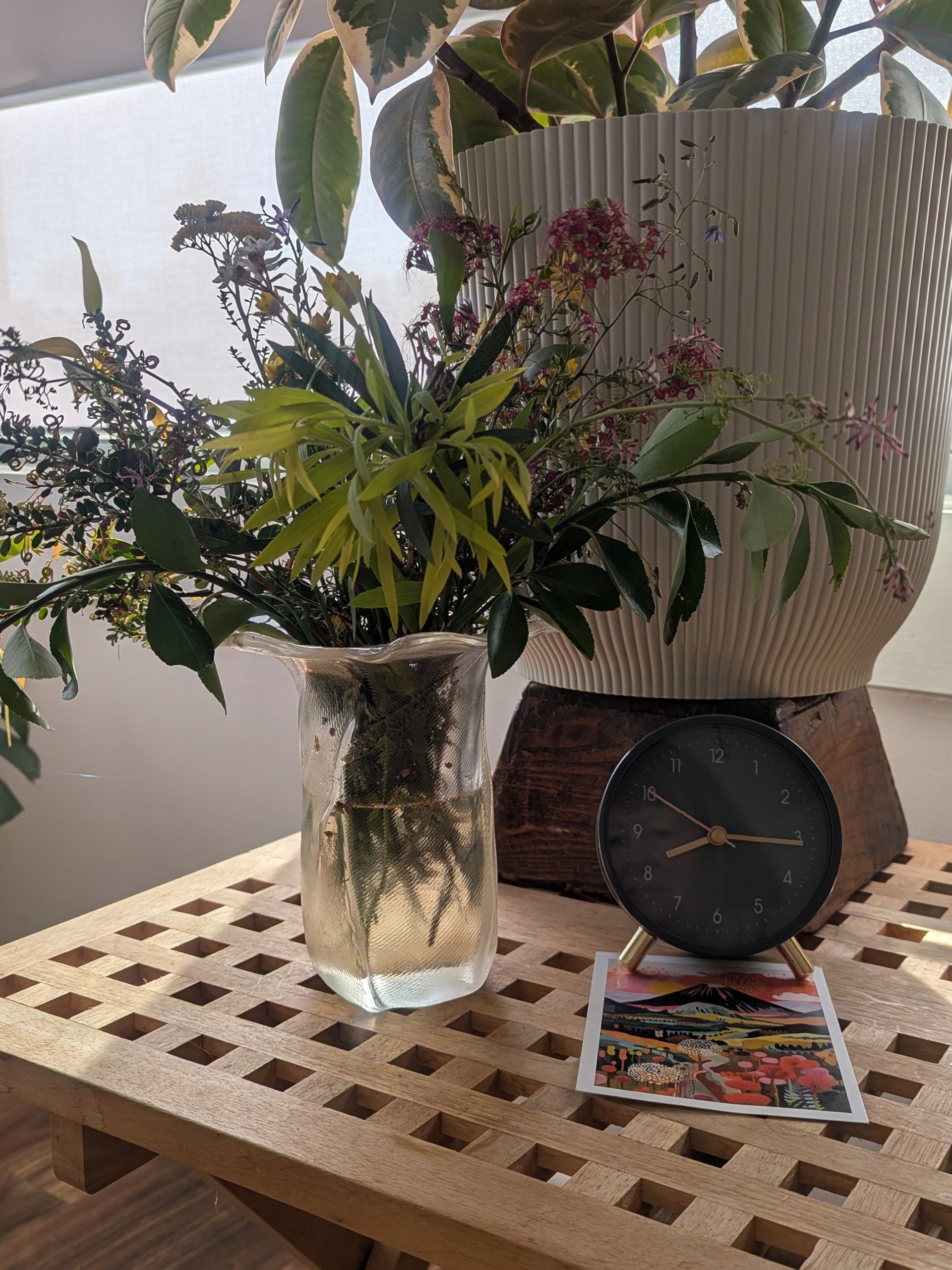
A real life photo (no stock image) snap from the Throughline Counselling room in Bendigo, Church Street, displaying a vase with native flora, a clock and a potted plant behind it.
It’s National Counselling Day on 27 October. In this context, I have reflected on the therapeutic work I do and how some people who come to see me in my private practice have their sense of self and identity shaped in conversations with AI bots and algorithms. It is difficult to avoid. AIs constantly offer to finish our sentences when we write texts to our friends. Gemini, Claude, and ChatGPT readily offer to finish our emails or create meeting summaries for us at work.
I am no exception, of course. AI is everywhere, and algorithms on social media and other platforms that we interact with influence us (consciously or not). It is difficult to avoid. AIs constantly offer to finish our sentences when we write texts to our friends, and Gemini, Claude and ChatGPT readily offer to finish emails or meeting summaries at work, and sometimes they offer to be our confidantes or therapists.
My reflection on AIs entering our relational space
Before I go on to talk about AI in the counselling room, if you wonder, this reflection is all written by me, and perhaps sometimes it shines through that English is not my mother’s tongue. There might be a bit of friction here and there, in my slightly unusual way of putting words together. But bear with me, friction is important, and I shall get to that!
Usually, the ‘other’ in the room is a client’s mother, father, partner, boss, friend or workplace, but a lot of people are now using AI as conversation partners. Hence, AI is indirectly present, even if not spoken about.
Importantly, as a counsellor who works with the dynamics of relationships, and that which is implicit and unspoken, I think there is value in exploring our relationships with AIs, just like we explore our human relationships and how they shape and affect us.
The friction in human interaction vs. the smoothness of AI
Now, I wish to emphasise something inherently important for human learning and development and also for how we develop resilience and heal from trauma or recover from mental illness: The importance of friction.
Friction is important in how we develop as humans. Present-day infant research by psychologist Beatrice Beebe shows that a little friction or rupture and repair in our caregiving relationships early on is what can help us develop resilience and also helps us develop empathy, as we learn that the other person we interact with has needs and thinks differently from us.
Paediatrician and psychoanalyst Donald Winnicott coined the concept of the ‘good enough mother’. In his book Playing and Reality, he explains that, over time, a baby and child gradually discover their caregiver as an ‘other’ rather than just an extension of themselves. For this development to happen, you need a ‘good enough mother’ who sometimes is not perfectly attuned but is able to notice a disjunction in the relationship and repair it.
The notion of friction was also discussed decades ago by paediatrician and psychoanalyst Donald Winnicott in his book Playing and Reality. Winnicott explains that, over time, a baby and child gradually discover their caregiver as an ‘other’ rather than just an extension of themselves. For this development to happen, you need a ‘good enough mother’ who sometimes is not perfectly attuned but good enough to repair the relationship.
Those of us who work beyond supportive counselling also know that the natural friction that occurs in the therapeutic relationship is not something to shy away from when it inevitably happens. Importantly, when a rupture is paired with empathic understanding and curiosity from your therapist, it can be healing and repairing—especially in trauma therapy and for someone who has experienced indifference and lack of emotional attunement in other relationships.
My point in describing what Beebe and Winnicott found, and drawing on clinical experience of the importance of rupture and repair, is that there is less friction when we use AI. You can pretty much ask it anything, and it will answer. No hesitation, no grumpiness. Instead, the AI will be ever so polite, and it never gets tired of you. This form of ever-present, overly helpful interaction has consequences when AI is used as a counsellor and confidante.
Can AI replace a counsellor?
I know some of you might be questioning if it is worth even seeing a counsellor if you can speak to an AI.
Rather than providing you with my opinions on whether AI is good or bad for you psychologically, if you came to see me, I would like us to think together and explore your relationship with AI and what feelings and thoughts you have.
If I fall into advice-giving, you might as well speak to an AI, as they will give advice, flatter you and soothe you, because they are built to keep you engaged and coming back to them. As a counsellor and narrative therapist who works psychodynamically, I will instead ask you to be curious about implicit thoughts, feelings and sensations.
Another significant issue is that there is no therapeutic frame, no ethical code of conduct, for an AI to hold on to—this is where a human counsellor with training, registration and ongoing supervision is different to an AI.
AIs are programmed to be pleasing. There is also the issue that they don’t really have a mind or body that has felt pain, pleasure, or sadness. An AI does not really know what it is like to be in the world, but it can pretend.
With AI, we therefore get a smooth performance that takes out the friction in human relating that is so fundamental for us to make space for our own thinking and choices and also relate to other people with empathy.
Empathy is important to keep in mind, and I will point you back to Winnicott’s thoughts on how we come to understand that other people are not extensions of us, but have minds of their own. This understanding develops, in part, through a little friction and is the fodder for developing mentalisation skills which are important in all relationships, parenting in particular.
Contemporary clinicians have begun exploring our interactions with technology. I particularly like Psychotechnical Becomings. Psychoanalysis, Identity, Desire, and Mourning in the Age of AI and Digital Mediation, by psychologist and psychoanalyst Alessandra Lemma. It is a fascinating book about how technology shapes our ‘psychic life and identity’ from the perspective of human attachment and development.
Lemma states that ‘It is not enough to ask what AI can do, or to use what it cannot do as an argument against it; we must ask what kind of relationship we are willing to foster with these omnipresent entities that are here to stay in some form or other’.
There is a lot more that can be said on this topic of AI and what it means for us, but if you are struggling with life and relationships (be they digital or human), my counselling colleagues and I welcome you into our virtual or in-person rooms across Australia.
We have university degrees, and our registration bodies, ACA and PACFA, require us to engage in a minimum number of supervision and professional development each year. Many of us also work in community mental health settings alongside our psychologist and social work colleagues.
Finally, unlike AI, counsellors have lived life. We are equipped to explore your stories and predicaments with curiosity and understanding of what it is like to live in a human body. We have walked unpredictable paths in our own lives, in contrast to AIs who use statistical prediction to interact with us.

A walking track on Dja Dja Wurrung Country, Central Victoria, October 2026. Photo by Throughline Counselling, Bendigo.